

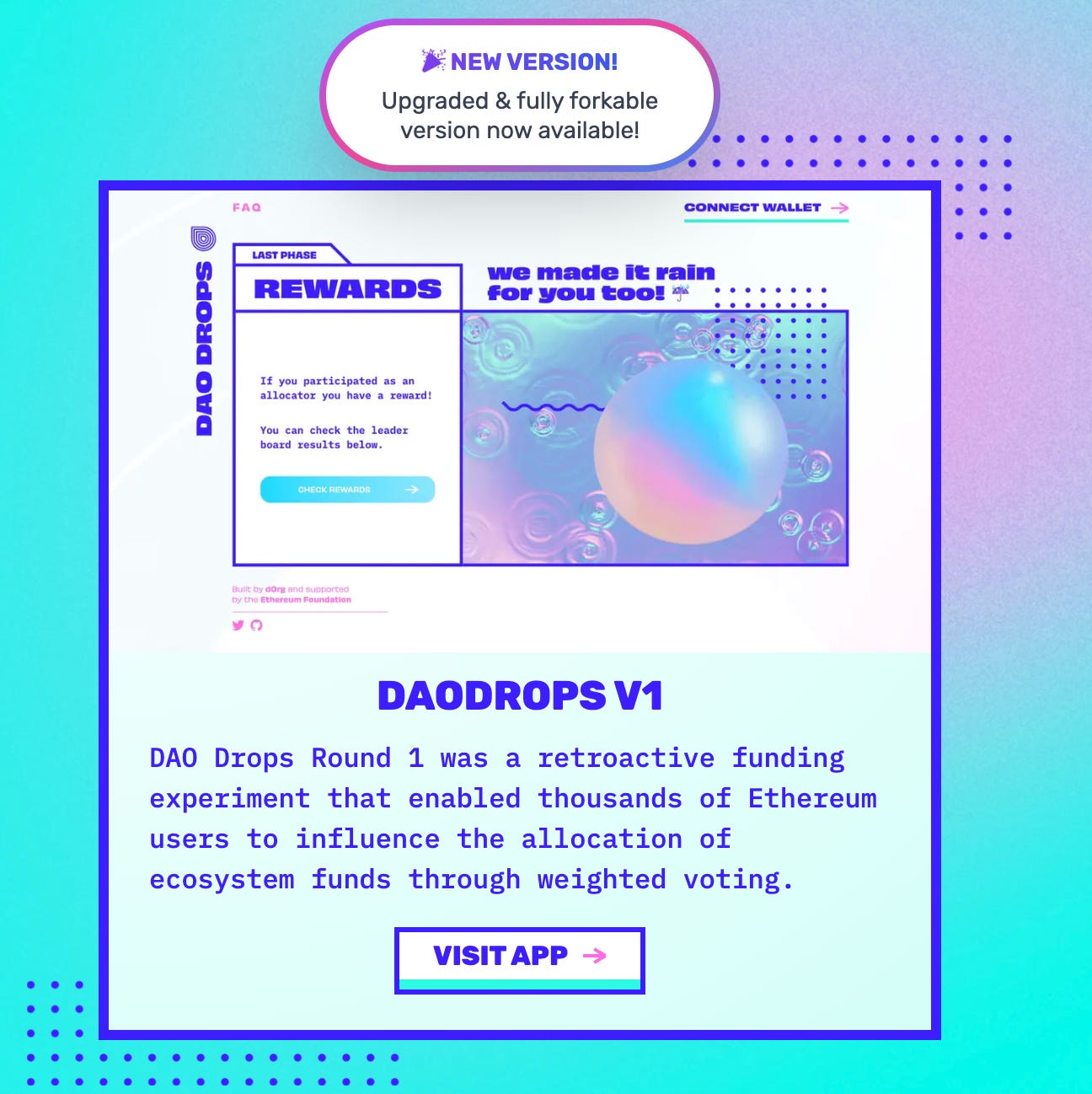
What if your community could run its own funding round, fully customized, transparent, and deployed in under an hour?
Over the last few years, Ethereum communities have relied heavily on large, centralized public-goods funding mechanisms. Programs like Gitcoin and Giveth helped bootstrap countless projects, experiments, and contributors.
But that landscape is changing. Funding sources are tightening, grant programs are becoming more competitive or winding down entirely, and many communities are realizing they need tools they can run themselves, without permission, complex infrastructure, and without sacrificing decentralization.
At the same time, Ethereum UX is still hard. Governance tools often feel intimidating, overly technical, or inaccessible to non-power users. If decentralized decision-making is going to survive and evolve, it needs to be approachable, transparent, and even enjoyable to use.
DAO Drops was built in response to this exact moment, and that’s what this post is about.
DAO Drops, originally launched as a live retroactive funding experiment, is now fully forkable. The exact system used in DAO Drops V1 has been refactored, documented, and released so any community can run its own round.
This is the complete voting interface, backend logic, and account scoring system that powered a real funding round, now packaged as reusable infrastructure.
If your DAO, conference, grant program, or community wants to run a funding or curation round without relying on shrinking public goods platforms like Gitcoin or Giveth, this is your alternative.
DAO Drops is a governance infrastructure you can own.
And here’s how it works:
What DAO Drops Is (and What V1 Proved)
DAO Drops is a decentralized application designed to help communities run funding rounds, voting processes, and project curation in a way that better captures the experience and wisdom of their stakeholders.
DAO Drops V1 was a real, live funding round, used by real projects and participants, with real constraints and learnings. It proved that:
Communities want alternatives to one-size-fits-all grant platforms
Retroactive funding can be transparent and engaging
Voting doesn’t need to feel bureaucratic to be credible
Most importantly, it proved that these systems should not be locked behind a single deployment.
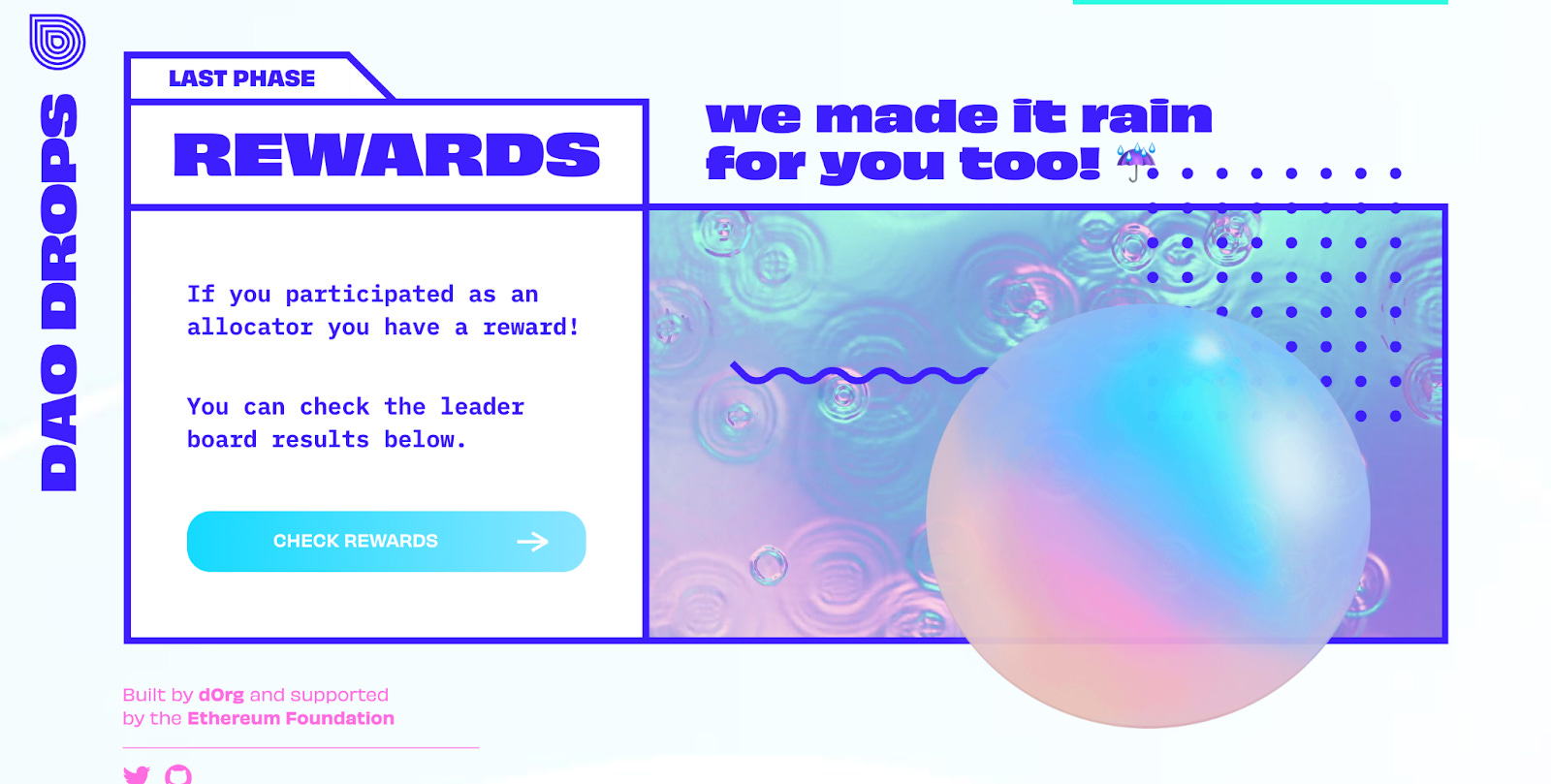
From One Round to a Forkable Primitive
DAO Drops was not originally designed as a forkable product. It began as a live funding round. After V1, participating projects and adjacent communities expressed interest in running similar rounds using the same infrastructure.
Today, the DAO Drops V1 codebase has been refactored, documented, and released as a fully forkable system, allowing anyone to run their own round using the same architecture that powered the original deployment.
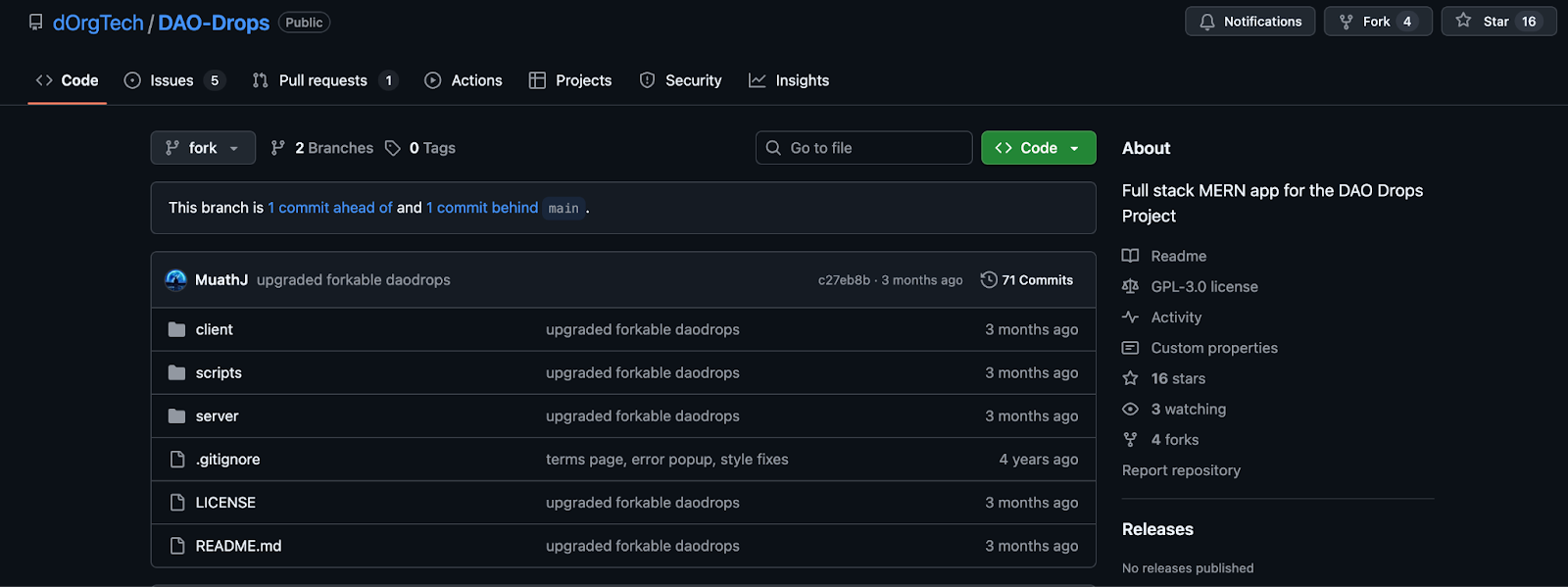
The live reference implementation is available now, and the forkable repository lives here
The forkable DAO Drops system is structured as a three-part monorepo, each component serving a distinct role:
Client (Voting App): the user-facing interface
Server (Backend): the logic and data layer for running a round
Scripts (Account Scoring System): optional tooling to weight participation based on experience
This separation makes it easy to customize one part without breaking the others, and allows communities to adopt only the pieces they need.
A Voting App Designed for Forking
The DAO Drops client is a Next.js-based voting application designed with one core principle: the code should explain itself.
Every file in the client codebase includes comprehensive inline documentation covering:
What the file does
How it fits into the application
Where and how it can be customized
Which state variables matter and why
How it interacts with the backend
All customizable text, colors, timing, and behavior are clearly marked with CUSTOMIZATION: comments and routed through centralized configuration files.
The result is a user interface that is intentionally simple, and a codebase that is intentionally transparent. Forking the app doesn’t require reverse-engineering decisions or hunting through undocumented components. You open a file, read the comments, and understand what to change.
Running a Full Funding Round End-to-End
Behind the interface sits a fully documented backend system that supports the complete lifecycle of a funding or voting round.
The server enables:
Project Submission
Participants submit projects for consideration, with reCAPTCHA protection to prevent spam. Alternatively, communities may choose to use a “scouts” approach, selecting representatives from different areas of the ecosystem to surface projects that might otherwise be underrepresented. This can help ensure a more well-rounded and diverse set of submissions before the curation phase begins.Curation Phase
Admins review submissions and select curated “picks” that move forward.Allocation Phase
Eligible users allocate points or votes to their preferred projects.Results & Export
All allocations and participation data can be exported for payouts, rewards, or analysis.
Because of this structure, DAO Drops can be used for:
DAO funding rounds
Grant programs
Hackathon judging
Community-led curation and ranking
It’s governance infrastructure that maps cleanly onto real-world coordination needs.
Account Scoring System
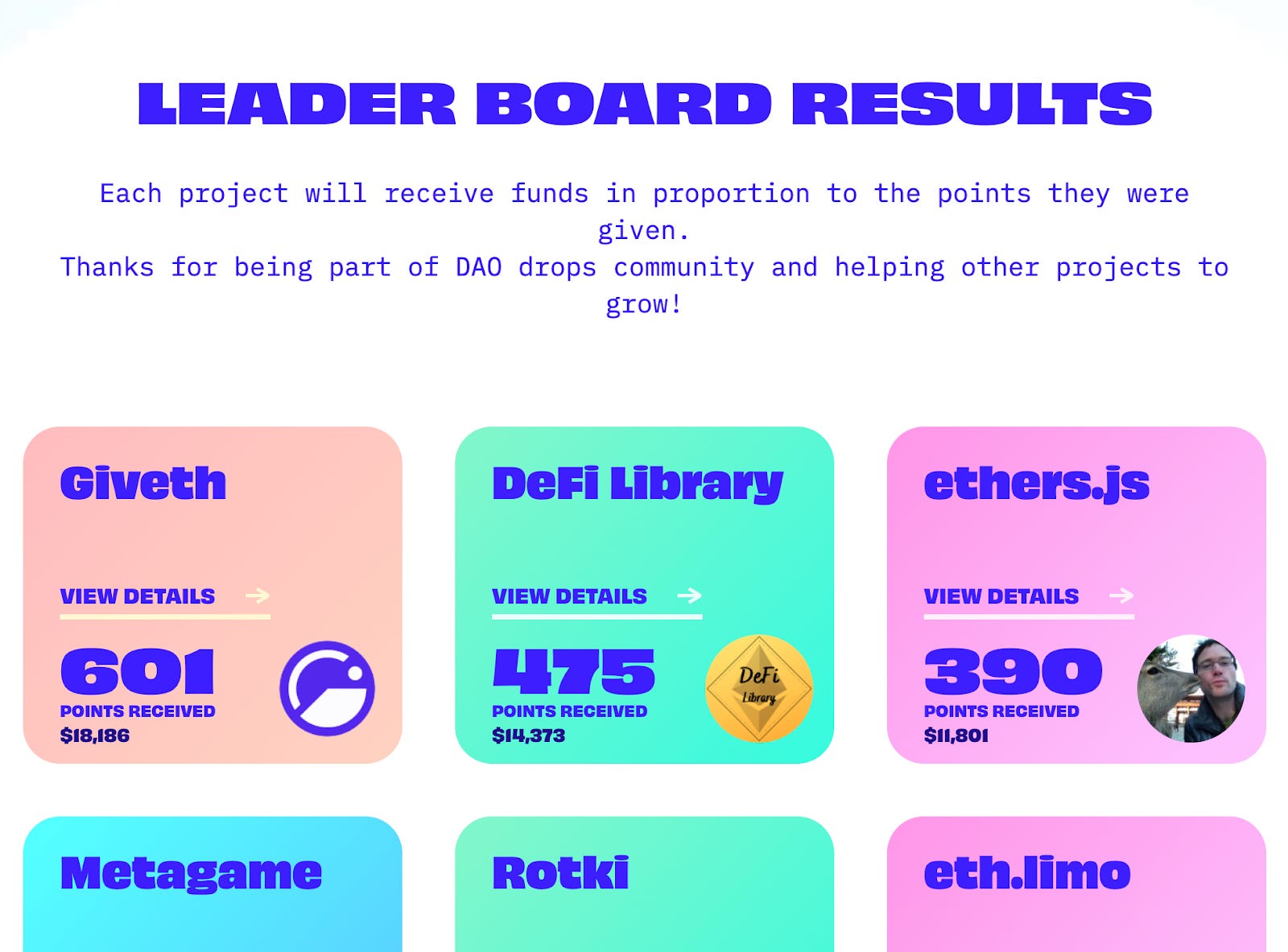
This is one of the most powerful parts of DAO Drops.
Instead of defaulting to “one wallet, one vote,” communities can choose to weight participation based on demonstrated engagement across the Ethereum ecosystem.
The scoring system can evaluate addresses using:
POAPs: attendance at events, hackathons, and gatherings
DeepDAO data: DAO participation and governance activity
Smart contract deployments: builder and developer engagement
Each data source can be used independently or combined. All configuration lives in a single file, making the system easy to fork, adjust, or simplify.
This enables use cases like:
Experience-weighted governance
Targeted airdrops
Builder identification
Community analytics
Ecosystem research
Or, if a community prefers simplicity, the scoring layer can be skipped entirely.
Research-Driven Design and UX Learnings
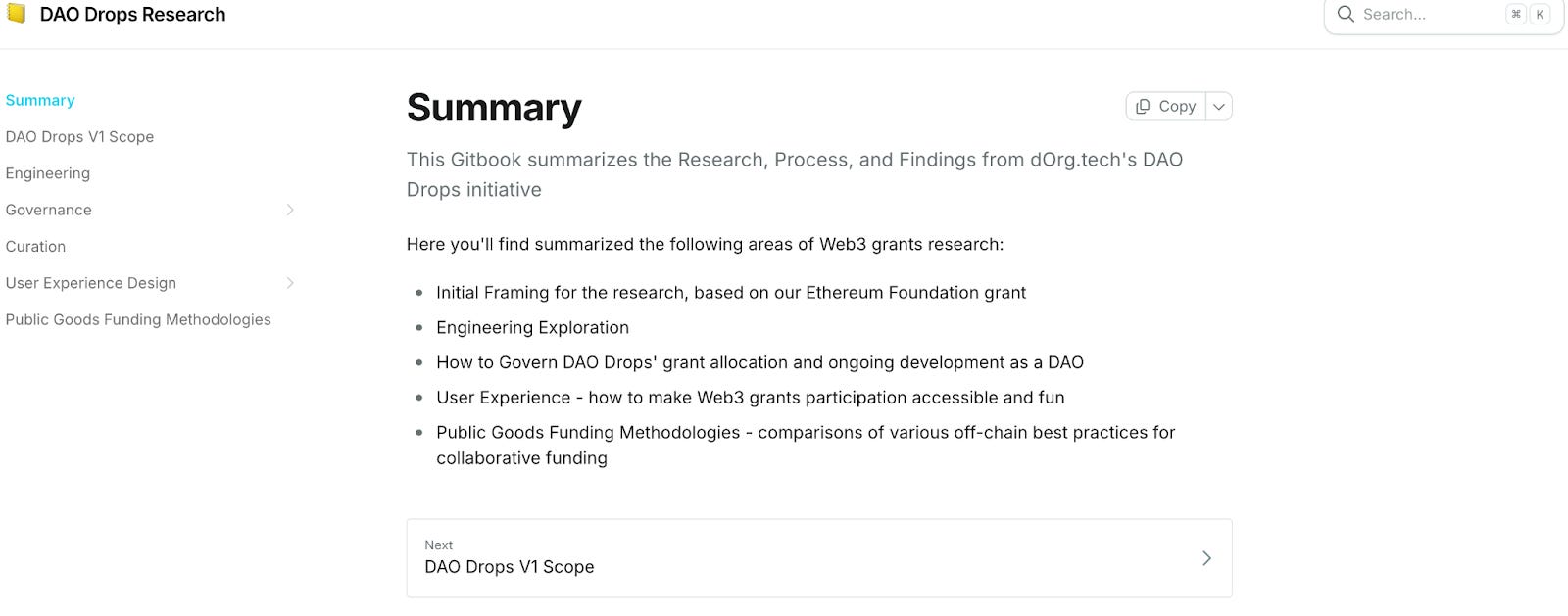
DAO Drops didn’t emerge in a vacuum. Alongside development, the team conducted ongoing research into governance design, curation practices, and user experience.
These findings (including best practices for project selection and lessons learned about accessibility in Ethereum interfaces) are documented in the DAO Drops Research Wiki.
The goal was not just to ship software, but to understand how people actually interact with decentralized decision-making tools, and how those tools can feel less intimidating without losing legitimacy.
Who DAO Drops Is For
DAO Drops is designed for communities that want ownership over their coordination tools, including:
DAOs running grant or funding rounds
Ethereum conferences and meetups
Hackathons and builder events
Public-goods communities
Governance and research experiments
Several Ethereum events have already expressed interest in running rounds using DAO Drops V1, and the system is well-suited for both local meetups and large-scale ecosystem initiatives, including events connected to Devcon and the Ethereum Ecosystem.
How to Run Your Own DAO Drops Round
Getting started is intentionally lightweight.
The forkable repository includes clear README files for:
The client
The server
The scoring scripts
With step-by-step instructions, most teams can fork the repo, configure their round, and run a local instance in around 30 minutes.
Everything needed to understand, customize, and deploy the system lives in the codebase itself. Below, you’ll find a video tutorial.
What’s Next for DAO Drops
DAO Drops V1 showed what’s possible. The forkable release is about letting the ecosystem take it further.
As more communities adapt the tooling to their own needs, DAO Drops becomes less of a single product and more of a shared governance primitive, one that evolves through use, experimentation, and iteration.
Get Involved
If you’re interested in running your own funding round, experimenting with decentralized voting, or contributing to the evolution of DAO Drops:
Explore the live app: https://daodrops.io/
Fork the repo: https://github.com/dOrgTech/DAO-Drops/tree/fork
Read the research: https://daodrops.gitbook.io/dao-drops-research
DAO Drops is built and maintained by dOrg, but its future is meant to be shaped by the communities that use it.
If you’re building something and need infrastructure that actually ships, this is an open invitation :)