

Most founders don’t regret hiring a smart contract development team. They regret what they didn’t know before.
By the time something feels off, contracts are live, users are interacting, and money is moving, making changes expensive or impossible.
The real problem is that most teams look the same during hiring, but the difference in outcomes is massive: one system evolves, the other breaks under pressure.
That difference is architecture.
Here’s what founders need to understand before they hire:
You’re not hiring for code, you’re hiring for decisions
If you approach smart contract development services as a coding task, you’re already underestimating the scope of the decision.
Especially when systems involve blockchain integrations, backend infrastructure, and frontend applications interacting with smart contracts.
Smart contracts don’t just implement features. They define how your system behaves, how value moves, who has control, and what happens when conditions change.
According to Ethereum, smart contracts are immutable by default, publicly accessible, and responsible for handling real value. That combination turns every design decision into infrastructure.
Similar challenges appear across ecosystems. In systems built on networks like Solana, teams must account for the chain’s unique account model and optimize for performance and composability under high throughput conditions, while in validity rollup systems like StarkWare, teams must design around proof generation constraints, Cairo’s programming model, and how both shape state transitions and scalability over time.
Across these environments, the pattern is consistent: architecture determines long-term viability, not just initial deployment.
This is where experienced teams differentiate themselves.
The question is not whether a team can build what you want. It’s whether they understand what those decisions imply over time.
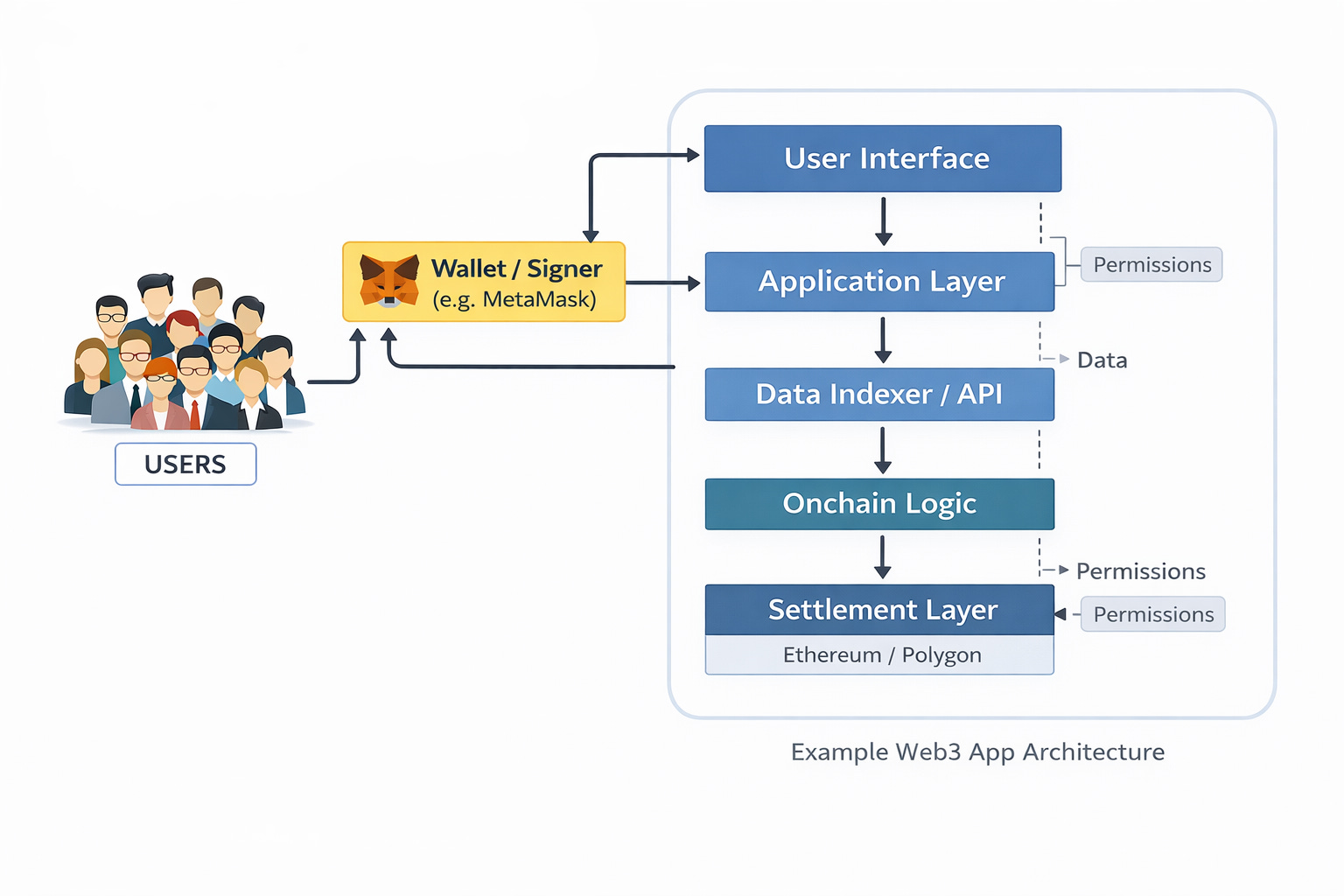
Architecture decisions are easy to make and hard to undo
Early decisions rarely feel critical. They feel reversible.
“We’ll upgrade this later.” “We’ll simplify now.”
But in smart contracts in blockchain, those assumptions don’t hold.
A small decision in permissions, upgrade patterns, or contract structure can turn into a major limitation once users, capital, and integrations are involved.
Guidance from OpenZeppelin consistently highlights that flexibility introduces complexity…and complexity increases risk.
In practice, this is where many teams run into friction post-launch. Systems that worked in isolation start to break under real usage conditions.
In dOrg’s work on protocols like USD0, part of the focus wasn’t just shipping contracts, but iterating on core logic, supporting integrations, and ensuring the system could scale without introducing critical vulnerabilities.
Good architecture prevents teams from having to rebuild under pressure.
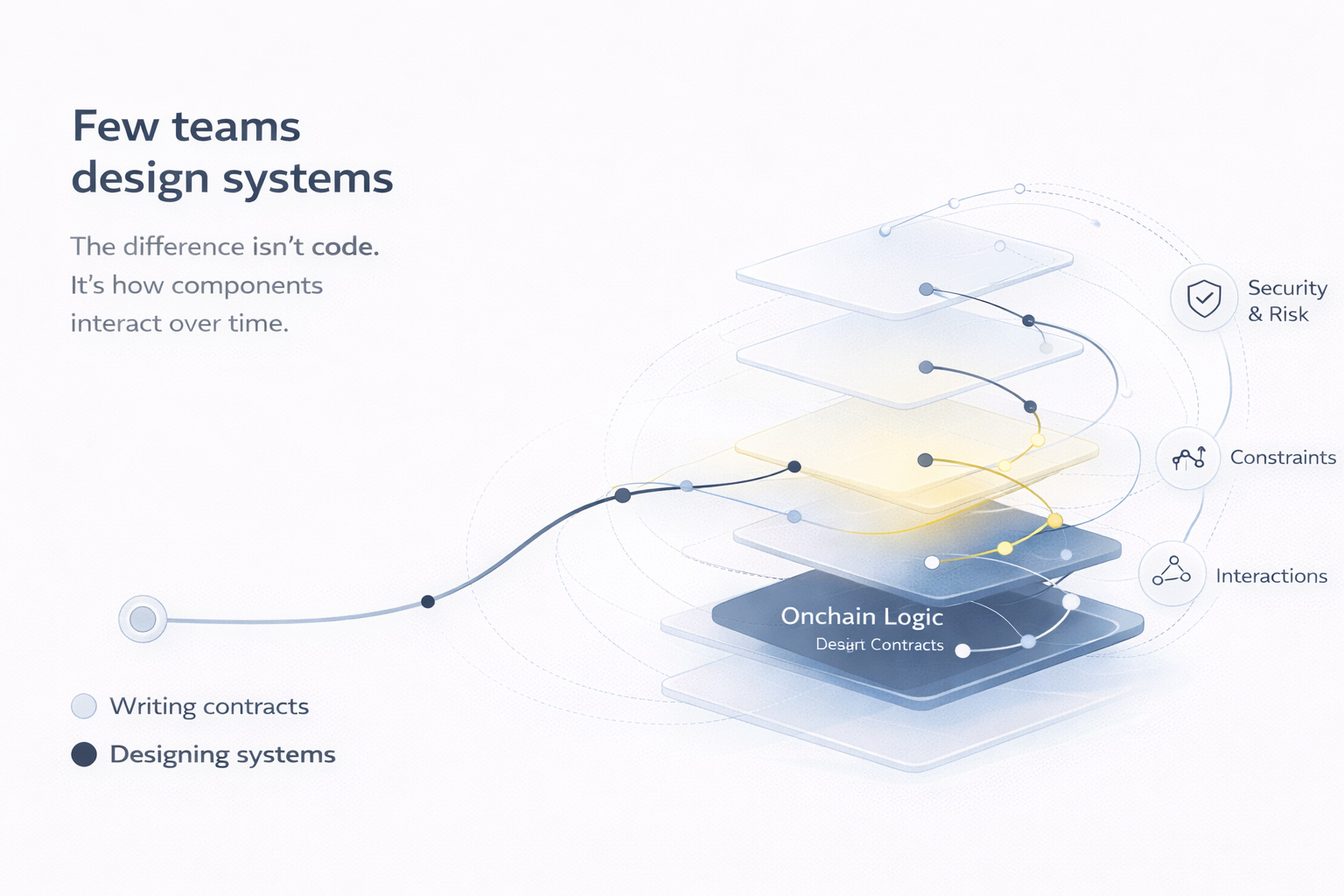
Few teams design systems
There’s a difference between writing contracts and designing systems.
Many providers of blockchain development services are optimized for execution. They take a specification and then ship it.
But systems don’t fail because code was written incorrectly.
They fail because:
assumptions didn’t hold
components didn’t interact as expected
constraints weren’t visible early enough
Strong teams spend more time understanding the system than implementing it.
They look at how contracts, data, and integrations interact across onchain logic, backend services, and frontend user interfaces.
That distinction is subtle during hiring, but becomes obvious once your protocol is live.
Upgradeability introduces flexibility and risk
Upgradeability often feels like a safety net.
If something goes wrong, you can fix it later, but that flexibility comes with tradeoffs.
As outlined by OpenZeppelin:
upgradeable systems increase complexity
expand the attack surface
require strict access control
They also introduce trust assumptions around who can modify the system.
Protocols across ecosystems, including those built with teams like Alpen Labs, often face similar tradeoffs between flexibility and security when designing upgradeable systems.
For some protocols, that tradeoff is necessary, but for others, it creates unnecessary exposure.
The important question isn’t “can we upgrade this?” It’s “what are we trading off by doing so?”
A strong smart contract development company helps you answer that before implementation, not after.
Your protocol doesn’t end at the contracts
One of the most underestimated parts of building in web3 isn’t your contracts.
It’s the layer that makes them usable: Data infrastructure.
Because once your contracts are live, a new problem starts:
Can you actually see what’s happening inside your system?
who is using it
what state your contracts are in
how value is moving
where things are failing
Raw blockchain data isn’t structured for products. It’s not queryable, readable, or usable at the application layer.
That’s where blockchain data indexing comes in.
This is what turns onchain data into something your backend, analytics, and frontend can actually use.
The Graph makes data queryable through public subgraphs, ideal when composability matters.
Goldsky pipes events into a database quickly, great for simple use cases, but you’ll hit limits when you need to transform or aggregate data.
Substreams handles high-throughput systems with powerful pipelines…but requires thinking in a map-reduce style architecture.
SubQuery aggregates data across chains into one API, reducing backend orchestration.
Ponder gives full control over performance and logic, but resilience is on you.
Pick wrong, and it won’t show early. It shows at scale.
When queries get heavier.
When your product depends on real-time data.
When you need to build analytics or automation on top.
Then you’re not switching tools but rebuilding a bottleneck.
This layer determines whether your team can:
debug without friction
ship interfaces that reflect reality
operate with reliable data
Your contracts define the system. Your data layer determines if it’s actually usable.
Security is a design problem before it’s a code problem
Audits are essential, but they are not the starting point for security.
Both Ethereum and Chainalysis highlight that many vulnerabilities originate from design decisions, not just code errors.
By the time code reaches an audit, core assumptions are already embedded.
Security begins earlier:
who has access
how permissions are structured
how complexity is managed
Audits validate correctness, they don’t fix flawed architecture.
What to evaluate before hiring a team
At a practical level, founders should shift how they evaluate smart contract development services.
Instead of focusing only on delivery, focus on how a team thinks.
Questions that tend to reveal this:
How do you approach architecture before coding?
What are the main failure points in this system?
What should not be onchain?
How does this evolve over time?
How will we monitor and understand the system once it’s live?
How will this integrate with our existing backend systems, frontend applications, and third-party blockchain integrations?
The quality of these answers often matters more than past deployments.
In Web3, launching is only the beginning.
The real challenge is everything that comes after: scaling, adapting, integrating, and operating under real conditions.
That’s why hiring a team for smart contract development services and blockchain developers is not just a technical decision. It’s a long-term product decision.
Because once your system is live, you’re operating within the constraints you designed.
So, before you hire a smart contract team, get a second perspective.
We’ve worked with protocols at different stages, from early design to scaling systems handling significant value.
If you want an architecture review or a second opinion on your current approach:
Reach out to dOrg